Northeastern Pennsylvania -
As reshoring accelerates manufacturing investment across the United States, workforce availability has emerged as the defining factor in site selection decisions. Since early 2025, companies have announced more than $1.2 trillion in new industrial projects, marking one of the largest development waves in decades. Yet, according to The Manufacturing Institute, the industry will require approximately 3.8 million new workers between 2024 and 2033, with nearly 1.9 million positions at risk of going unfilled if workforce gaps persist.
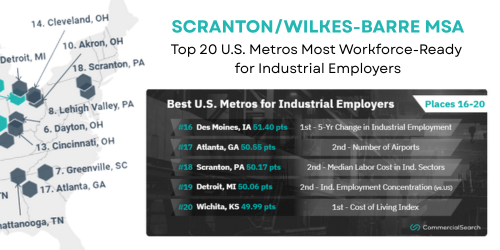
Against this backdrop, the Scranton–Wilkes-Barre Metropolitan Statistical Area has earned recognition as one of the nation’s most workforce-ready regions, ranking #18 among the Top 20 U.S. metros for industrial employers.
Workforce Strength Anchors the Region’s Competitiveness
The Scranton–Wilkes-Barre metro distinguishes itself through a strong and sustained pipeline of industrial talent. The region boasts approximately 238 registered industrial apprentices per 10,000 residents, one of the highest concentrations among the nation’s largest metros. This reflects a coordinated regional focus on aligning workforce development with employer needs.
Manufacturing and skilled-trade training have been strategically integrated into college curricula, technical programs, and workforce development initiatives, ensuring a consistent flow of qualified workers into key industrial sectors. This alignment between education providers and industry has become a defining advantage for employers seeking long-term labor stability.
Infrastructure, Incentives, and Cost Advantages
Beyond workforce readiness, the Scranton–Wilkes-Barre metro offers strong financial and infrastructure support for industrial growth. Employers benefit from accessible financing programs designed to support both small-scale expansions and larger capital investments. In 2024 alone, more than $28 million in state redevelopment funds were awarded across the metro to support growth-oriented projects.
The region also continues to modernize its industrial inventory. In a prior ranking, Scranton–Wilkes-Barre placed among the nation’s best metros for new manufacturing space, with 26% of its industrial inventory built after 2000 - a key differentiator for companies seeking efficient, Class A facilities.
Cost competitiveness further strengthens the region’s appeal. Scranton–Wilkes-Barre posts some of the lowest median industrial wages among top-ranked metros, providing employers with a meaningful operational advantage without sacrificing workforce quality.
Strategic Location in the Northeast
Located within the heart of the Northeast, the Scranton–Wilkes-Barre metro offers access to regional and national rail networks, connecting employers to major markets throughout Pennsylvania and the broader Northeast corridor. This strategic positioning enhances supply chain efficiency while maintaining proximity to population centers.
A Workforce-Ready Metro for Industrial Growth
With its deep labor pool, strong apprenticeship pipeline, modern industrial facilities, competitive costs, and coordinated workforce strategy, the Scranton–Wilkes-Barre metro continues to prove itself as a top-tier location for industrial employers navigating today’s reshoring and expansion decisions.
Ranking #18 nationally, the region stands out not only for its readiness today, but for its capacity to support sustained industrial growth well into the future.
#ChooseNEPA by contacting Penn's Northeast at pennsnortheast.com
View the rankings and supporting data for the Top 20 U.S. Metros Most Workforce-Ready for Industrial Employers by Commercial Search at the link below.
