Wilkes-Barre, Luzerne County, PA -
Northeastern Pennsylvania is positioning itself as a hub for the next generation of digital infrastructure.
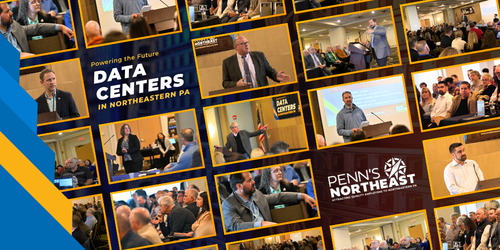
More than 150 business, education, utility, and government leaders gathered Friday at the DoubleTree by Hilton in Wilkes-Barre for a Penn’s Northeast seminar exploring the rapid growth of data centers, hearing firsthand from industry experts, utilities, workforce developers, and policy leaders.
Hosted by John L. Augustine, president and CEO of Penn’s Northeast, the morning-long event covered topics ranging from local zoning and construction requirements to energy demands, workforce readiness, and economic impact.
“With AI adoption and cloud expansion accelerating nationwide, the region must ensure that infrastructure, utilities, workforce development, and public policy are aligned to support continued growth,” Augustine said. “This forum highlights NEPA’s ongoing momentum, showcases regional coordination efforts, and provides insights on sustaining our role in the evolving digital economy.”
Defining Data Centers and NEPA’s Opportunity
The opening session featured industry leaders Merle Madrid of Amazon Web Services and Curry Roberts of Parkway Strategies LLC, who provided a foundational look at how and why data centers are being developed nationwide.
“The focus should be on approving the right projects and setting the right rules for how they are built,” Madrid said, emphasizing that thoughtful planning and collaboration are key as communities evaluate proposals. He added that Pennsylvania is well-positioned to compete for data center investment due to its infrastructure and energy assets.
Roberts reinforced the importance of proactive planning at the local level. “Communities should establish clear ground rules now - where data centers can be located, how close they can be to neighborhoods, and the standards they must meet,” he said. “That clarity helps ensure responsible development and gives both communities and developers a roadmap for success.”
Together, the speakers underscored that early coordination between municipalities, developers, and stakeholders is critical to maximizing the benefits of data center growth while addressing community concerns.
Economic Opportunity and Regional Strength
Augustine highlighted the scale of opportunity tied to the industry, noting that data centers are the backbone of modern technology.
“Data centers are specialized, secure facilities that house thousands of servers and systems to store and process massive amounts of digital information,” he said. “They power everything from cloud computing to artificial intelligence.”
He added that Northeastern Pennsylvania has 29 data centers currently on the planning map, with approximately 15 expected to be completed.
“The economic impact for the area will be significant, creating more high-paying jobs than the region has ever experienced,” Augustine said.
The industry has already contributed $2.1 trillion to U.S. GDP between 2017 and 2021, with Pennsylvania seeing $14.4 billion in economic impact in 2023 alone.
Infrastructure & Workforce Readiness
Panel discussions throughout the morning addressed the critical components needed to support data center growth, including energy capacity, water resources, fiber connectivity, and workforce development.
Utility representatives from Comcast, Pennsylvania American Water, PPL Electric Utilities, UGI, and the Susquehanna River Basin Commission discussed coordinated infrastructure planning and the importance of reliability and capacity.
Workforce leaders including John Yudichak, President of Luzerne County Community College; John H. Olejnick of IBEW; Tony Seiwell of LIUNA; and Warren Faust of Northeast PA Building & Construction Trades emphasized the scale of labor demand tied to the industry.
Yudichak highlighted the scale of opportunity, noting that “The $10 billion Amazon Web Services AI Data Center campus being constructed in Luzerne County is currently employing thousands of skilled trade workers and will generate millions of new tax revenue. By 2030, Pennsylvania will need 300,000 skilled trade workers across critical industry sectors of technology, energy, manufacturing, and healthcare.”
He also highlighted PA Works!, a statewide workforce strategy with Pennsylvania’s community colleges to build the first-in-the-nation pipeline of skilled trade workers starting in career and technical high schools and continuing through community colleges.
Policy, Planning, and Community Considerations
Representatives from the Pennsylvania Chamber of Business & Industry, Barry Isett & Associates, and George Stark of the Pennsylvania Energy & Innovation Institute moderated discussions on local and state policy.
Stark emphasized the need for proactive planning: “If you’re coming, you need to do it our way,” Stark said, stressing that communities should establish zoning and regulatory frameworks before projects are proposed.
Panelists also noted that Pennsylvania law prohibits municipalities from banning data centers and that zoning ordinances must accommodate their development.
NEPA Positioned for the Digital Economy
Augustine concluded by underscoring the region’s readiness: “Northeastern Pennsylvania has the skilled workforce, infrastructure, and educational systems to support the rapid growth of AI and cloud computing. Our region is ready to power the digital economy responsibly and sustainably.”
As digital demand continues to grow - modern households now average 21 connected devices, and global streaming exceeds 200 million hours of content on Netflix every day - Northeastern Pennsylvania is emerging as a key hub for data center investment, economic growth, and high-paying jobs.
Representatives throughout the day emphasized that while data center growth presents challenges, it also represents a significant opportunity for job creation, tax base expansion, and long-term economic development in Northeastern Pennsylvania.
As the seminar concluded, one theme was clear: Northeastern Pennsylvania is increasingly positioned at the intersection of energy, infrastructure, and digital innovation - and must continue aligning policy, workforce, and planning efforts to fully capture the opportunity ahead.
